The Interrelationship Between Chhanda in Sanātana Literature and Contemporary Indian Music
In the Sanātana Indian tradition, word, sound, and rhythm are not regarded merely as tools of expression, but as fundamental elements of cosmic consciousness itself. Indian philosophical thought considers literature (vāṅmaya), poetic meter (chhanda), and music not as separate disciplines, but as manifestations emerging from the same primordial principle—Nāda. Nāda is described as the first expression of Brahman, from which sound arises, from sound emerges meaning, and from meaning flows emotion. From this perspective, chhanda and music are not independent artistic systems, but two streams of a single eternal continuum that has manifested itself in diverse forms across time.
The very composition of the Vedas serves as the earliest and most authoritative evidence of this truth. The hymns of the Ṛgveda are inherently metrical, and their recitation follows a strict rhythmic discipline. The Sāmaveda, in particular, is entirely based on the tradition of singing, wherein mantras were structured through specific tonal patterns. It would not be an exaggeration to describe the Sāmaveda as the foundational text of Indian music. The synthesis of meter, melody, and rhythm found here later evolved into the core framework of Indian musical thought. The Vedic seers clearly understood that words attain potency only when united with rhythm, and rhythm becomes alive only when infused with meaning and emotion.
The essence of chhanda lies not merely in the calculation of syllables, but in organizing the flow, pause, and articulation of language so as to leave a deep impact on the listener’s mind and consciousness. Vedic meters such as Gāyatrī, Anuṣṭubh, Triṣṭubh, and Jagatī exemplify this principle. Each meter possesses its own internal musicality that naturally emerges during recitation. This intrinsic musical quality later evolved into the systematic concepts of tāla (rhythm) and laya (tempo). Thus, chhanda may be regarded as the intellectual and philosophical foundation of Indian music.
In the Sanskrit poetic tradition, meters developed into highly refined and nuanced forms. Poets such as Kālidāsa, Māgha, Bhāravi, and Bhavabhūti treated chhanda not merely as a technical constraint, but as a powerful medium of emotional expression. The slow and grave movement of Mandākrāntā evokes longing and pathos, while the vigorous cadence of Śārdūlavikrīḍita amplifies heroism and energy. It is no coincidence that readers experience a distinct musical resonance while reading these meters aloud. This resonance is the very basis of the intrinsic relationship between poetry and music.
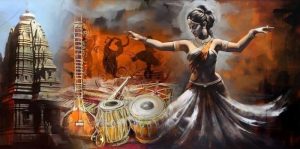
Indian classical music also reflects this chhanda-based consciousness in its systems of rāga and tāla. Just as a poetic meter depends upon a balance between heavy (guru) and light (laghu) syllables, musical rhythm relies upon an equilibrium of beats and divisions. Rhythmic cycles such as Tīntāl, Ektāl, and Jhaptāl may be seen as musical manifestations of metrical syllabic organization. Similarly, the time-theory of rāgas is closely connected with the Vedic understanding of time, seasons, and cosmic order. Thus, the influence of chhanda on music is not merely poetic, but philosophical and scientific.
With the advent of the Bhakti movement, the relationship between meter and music became even more intimate. Poetry was no longer confined to aesthetic refinement or scholarly display; its purpose shifted toward communicating devotion and emotion to the masses. The chaupāīs of Tulsidas, the pads of Surdas, and the bhajans of Mirabai are all metrical compositions whose full essence is realized only through singing. Here, chhanda merges with vernacular language and folk melodies, giving rise to a living tradition that continues to thrive in Indian society. This demonstrates that chhanda was never restricted to classical texts, but became deeply embedded in popular culture.
Folk music represents perhaps the most vivid and organic expression of this eternal relationship between meter and melody. Although folk compositions may not explicitly adhere to classical rules, they invariably contain an intuitive metrical discipline. Genres such as Sohar, Kajri, Chaiti, Birha, and Alha naturally maintain rhythmic balance and syllabic harmony. This suggests that chhanda is not merely a scholarly construct, but a cultural memory deeply ingrained in the collective Indian psyche, transmitted across generations through musical expression.
A close examination of modern Indian music—particularly film music—reveals that it too remains rooted in metrical structure. The organization of verses, refrains, rhyming patterns, repetition, and rhythmic cycles are all contemporary manifestations of chhanda. Even when lyricists employ free verse or Western musical influences, a song cannot achieve emotional impact without an underlying rhythmic coherence. This internal rhythm is nothing but a modern expression of the ancient metrical consciousness.
The relationship between chhanda and music is not only technical but profoundly spiritual. Indian philosophy introduces the concept of Nāda Yoga, which emphasizes the role of pure sound and rhythm in concentrating the mind and elevating consciousness. Practices such as mantra recitation, kīrtana, and bhajana are grounded in this principle. Here, chhanda provides structural discipline, while music imbues the practice with emotional vitality. Together, they transform sound into a spiritual experience.
In contemporary times, as music increasingly becomes commercialized and consumption-driven, understanding this ancient interrelationship becomes even more crucial. If music is reduced to mere entertainment and meter is confined to literary mechanics, both lose their deeper essence. Indian tradition teaches that art is not solely meant for pleasure, but also for the refinement and elevation of consciousness. This higher purpose can only be fulfilled through the harmonious union of chhanda and music.
This perspective calls for a reassessment of modern education and training systems. Students of music should be introduced to the fundamentals of poetic meter, while students of literature should be sensitized to musical rhythm and sound. Without this interdisciplinary integration, a holistic understanding of Indian artistic heritage remains incomplete. The bond between chhanda and music is not merely a relic of the past, but a guiding principle for the future.
In conclusion, the relationship between chhanda in Sanātana literature and contemporary Indian music represents a living, dynamic, and continuous tradition. While languages, forms, and styles have evolved over time, the underlying consciousness has remained unchanged. Chhanda imparted discipline to music, and music infused vitality into chhanda. This non-dual relationship constitutes the unique essence of Indian culture—a tradition that embraces transformation while remaining eternally rooted in its primordial principle of Nāda.
About the Author